To cast a bell
The principle of casting bells has remained essentially the same since the 12th century. Bells are cast mouth down, in a two-part mould consisting of the core and a mantle or cope placed over it. These are produced to accurate profiles so an air space exists between them which is filled by the molten metal.
Measurement and templating
Firstly the bell profile is calculated to exact specifications to ensure it can be properly tuned. Two wooden templates called “strickle boards” are used to shape the moulding clay. One matches the dimensions of the outer bell (called the case or cope); the other matches that of the inner bell (called the core). Generally these boards are stock profiles that have been developed, empirically and by calculation, for each size of bell.
Constructing the mould
An exact model of the inner face of the bell is built on a base-plate using porous materials such as coke, stone, or brick. It is then covered first with sand or loam (sometimes mixed with straw and horse manure) and clay to form a smooth profile. This is given a profile by means of the inner strickle board. It also known as the “false bell” and is then dried with gentle heat in a kiln. The false bell is then covered with molten wax and figures and inscriptions, also made of wax, applied on top by hand. The false bell is painted over with three coats of fireproof clay and then enclosed by a steel mantle overcasing. The empty space between the false bell and the mantle is filled in with cement and left to harden before the mantle is lifted off. The false bell is chipped away from the inner core to leave the wax and cement. Any leftover scraps of the false bell are removed with a blow torch. The mould is then set over a coke fire to melt the remaining wax and evaporate any water that has accumulated.
Instead of using a steel mantle and cement, the inner and outer moulds can also be made completely out of loam. In that case, the moulds are usually constructed inside out—first the inner mould on top of a coke, stone, or brick core, then the false bell including wax decorations as above, and finally the outer mould with added iron ring and fiber (e.g. hemp) reinforcements. At this stage the steel staple, from which the clapper will hang, is inserted. Separating agents are used to prevent the false bell from sticking too closely to both of the moulds. Finally, after lifting up the outer mould, the false bell can be destroyed and the outer mould lowered back down onto the inner mould, ready for casting.
Pouring the metal
The outer bell mould in the cope or mantle is lowered over the inner mould and they are clamped together, leaving a space between them, which the molten metal will fill. The complete mould is sometimes in a casting pit which stabilises it and enables slower cooling, or above ground in open air, depending on the foundry’s traditions.
The raw materials of copper and tin are melted in a furnace until they become liquid at a temperature of approximately 1,100 °C (2,010 °F). Often scrap bronze from old bells is added, especially if the bell being cast is a replacement for an existing bell, which is in effect being recycled.
The liquid metal is skimmed to remove impurities, then poured into the mould, using either a tilting ladle suspended from a crane, or else a system of brick channels constructed in the casting pit, which allows the metal to flow directly from the furnace into the individual moulds. As the metal enters the mould, holes in the top of the mantle ensure that gases are able to escape, otherwise there would be a risk the bell would be porous and susceptible to cracking.
So there you have it (Thanks Wikipedia – couldn’t have said it better myself.
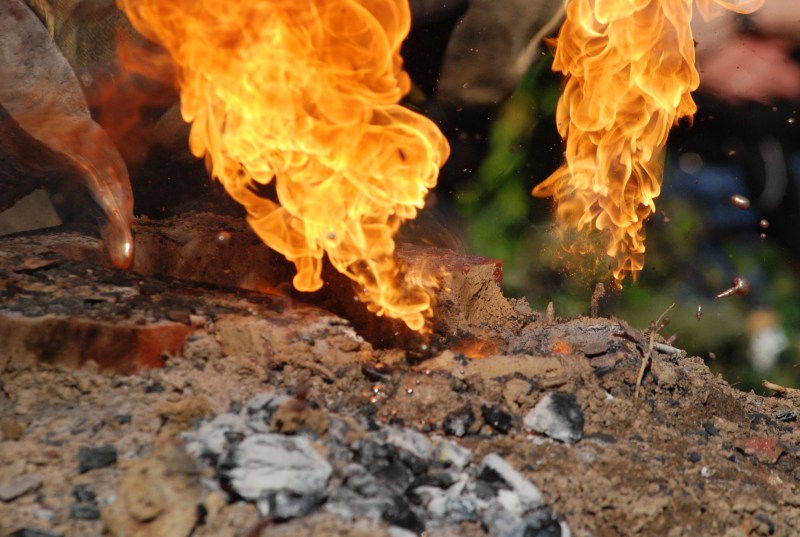
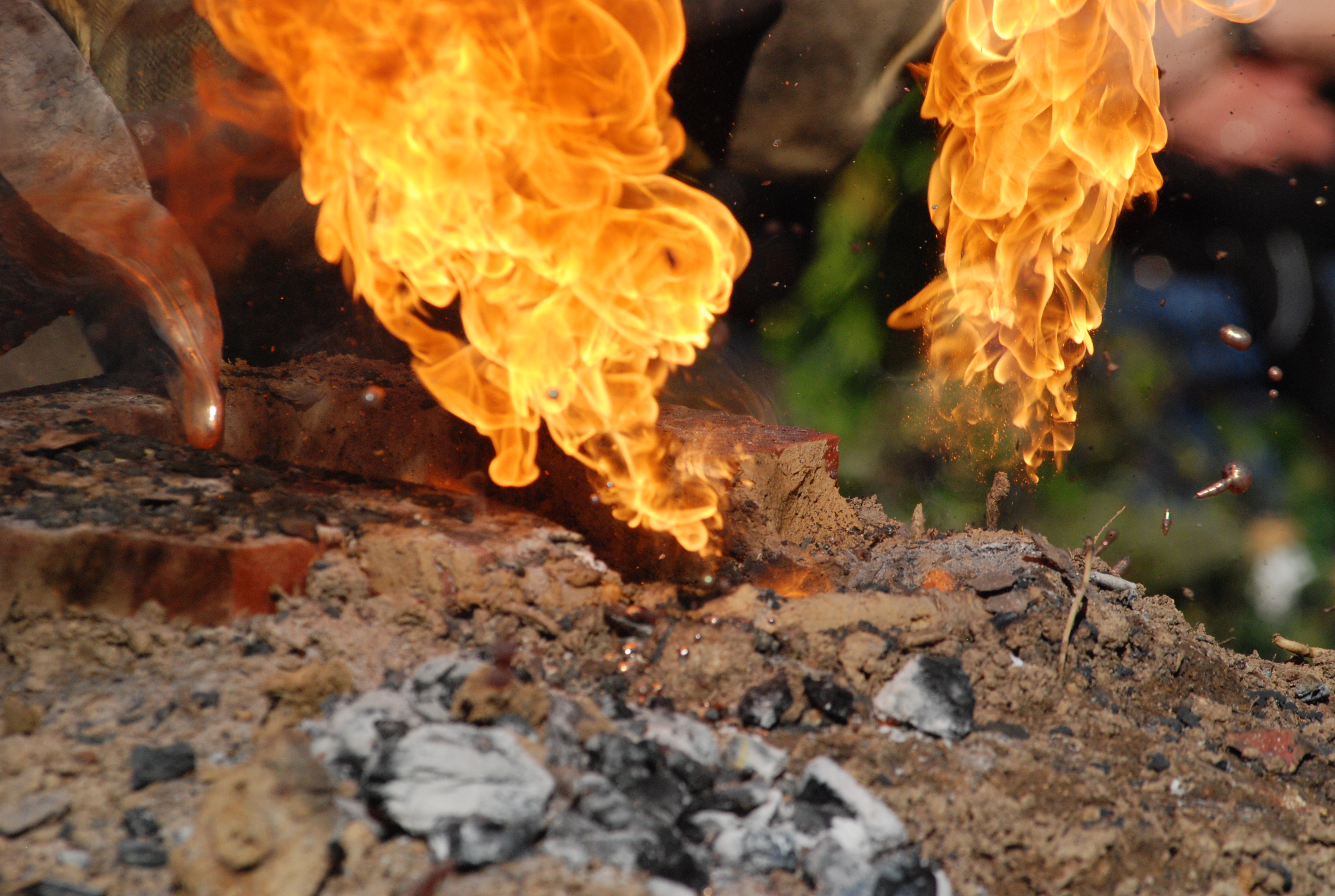
So this is the “Pouring the metal” bit, with 1100°C returning to the atmosphjere at speed, and distributing globules of bell metal that weren’t strong enough to stay put.

Then, of course there’s “Feier”.
Pronounced the same, means celebration.
And brother, is that ever happening around here…..
Karneval is writ large in Mainz.
Kicks off on 11 November (at 11:11) and then goes pretty much underground (unless you’re deeply involved) until the day before yesterday, being Weiberfastnacht (or Fat Thursday)when the females of the species let themselves off the leash and create havoc and mayhem.
If you’re wearing a tie (not that anyone does these days..) , they’ll chop it off in a simulated emasculation and generally carry on with reckless abandon and cavorting, primarily involving the consumption of multiple alcoholic beverages in quantity, random mating and participation in pavement pizza contests.
All of which I observed at close quarters as I gravel-biked my way through the throngs on the way for a celebratory doppio at the Kaffeekommune, having survived a 60-ish km ride at 6°C, with headwinds whichever you turned, ankle-deep mud and hailstorms.
Not that I’m complaining of course..
And it keeps gaining pace until its culmination on Rose Monday with a parade (as pictured above, except with a cast of around 1000 and close to a million devotees, letting themselves off the leash in similar fashion to the above.
I’m staying well away from it…
 Mainz Daily Photo
Great for theme day.