>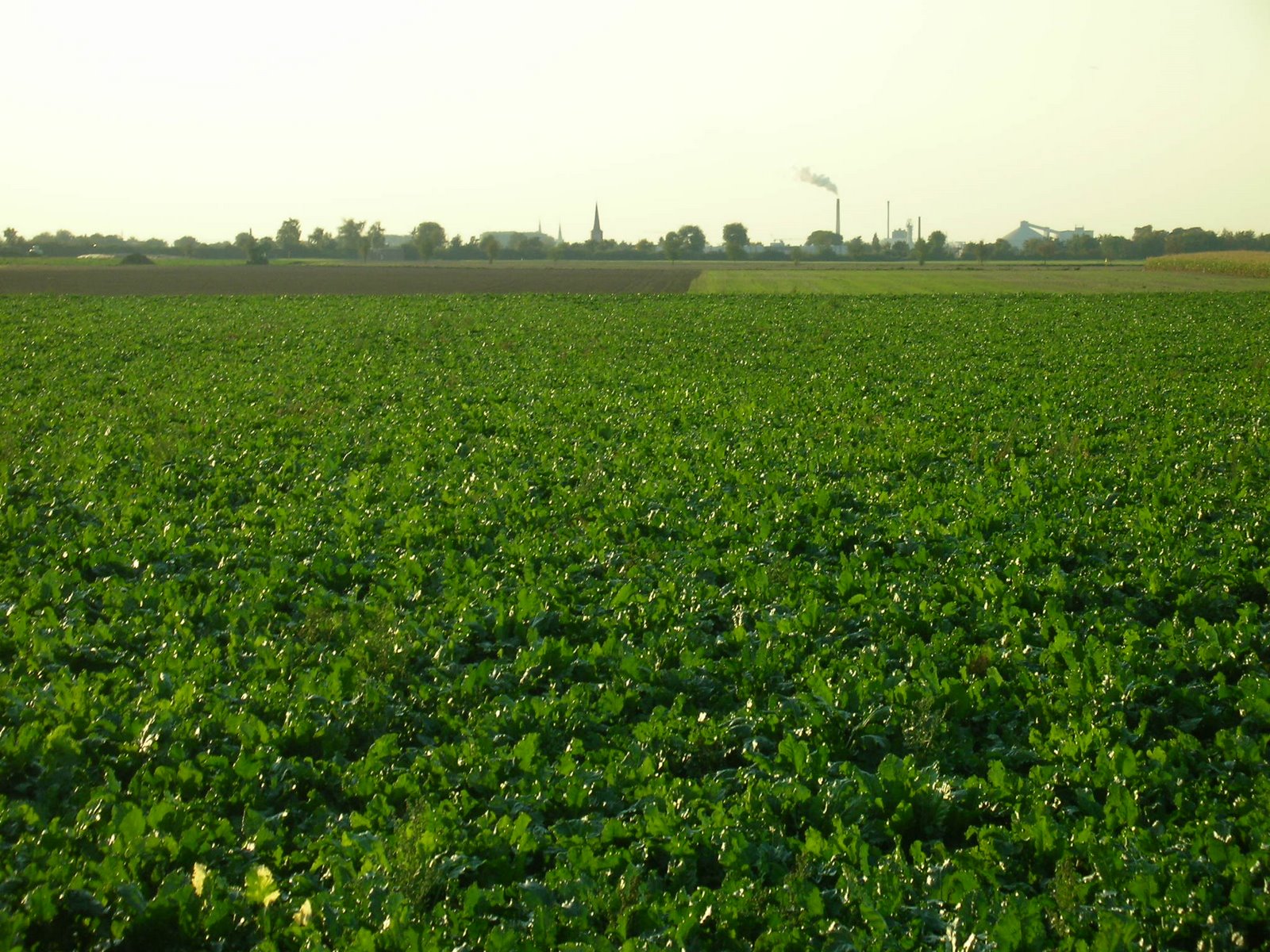 Sugar beet fields with the refinery merrily steaming away in the background
Sugar beets used to be one of THE crops around here.
Still is, with 25 million tons produced in 2005, although a combination of subsidy reduction and higher prices for alternative crops sees more and more acreage being converted to maize for biogas production and cattle feed.
Interesting history, too.
Beets were first processed commercially in the early 19th C, when they only had 5-6% sucrose compared with 20% these days.
Production really kicked in during the Napoleonic Wars, when the Brits began a blockade of France, preventing its access to sugarcane. The French subsequently did the same to the Brits, resulting in flourishing sugar beet industry on both sides of the Channel.
It’s a hell of a process to remove the sugar from the beet.
First they’re washed, then chopped, then soaked in water during the diffusion process, then pressed to extract the moisture (the fibrous residue is used as fodder), then carbonated to remove the non-sugar in the liquid, boiled to evaporate the water and then spun before getting a final heating with hot air.
And if you think THAT’S a hell of a process, just look at how they used to be harvested, this from Wikipedia
Up until the latter half of the 20th century, sugarbeet production was highly labour-intensive, as weed control was managed by densely planting the crop, which then had to be manually thinned with a hoe two or even three times during the growing season. Harvesting also required many workers.
Although the roots could be lifted by a plough-like device which could be pulled by a horse team, the rest of the preparation was by hand. One labourer grabbed the beets by their leaves, knocked them together to shake free loose soil, and then laid them in a row, root to one side, greens to the other. A second worker equipped with a beet hook (a short handled tool something between a billhook and a sickle) followed behind, and would lift the beet and swiftly chop the crown and leaves from the root with a single action.
Working this way he would leave a row of beet that could then be forked into the back of a cart.
These days, harvesting is completely mechanised – just sit in your air-condition cab, listening to the radio and the big machine you’re dragging behind you does the rest.
A bit late for Lieschen Schmitz,my mother-in-law, though.
At 86, she spent most of her working life doing the italics stuff.
Not a big surprise that she can’t move without pain

 Mainz Daily Photo
>I can see the next image of rape fields .. all decked out in yellow. I enjoy the blog. cheers Jeremy. WLG, NZ
>Really interesting information, John. In Wisconsin, my first exposure to diversity (and ugly prejudice) occurred during the harvest season of sugar beets as the migratory workers arrived to do their back-breaking labour!